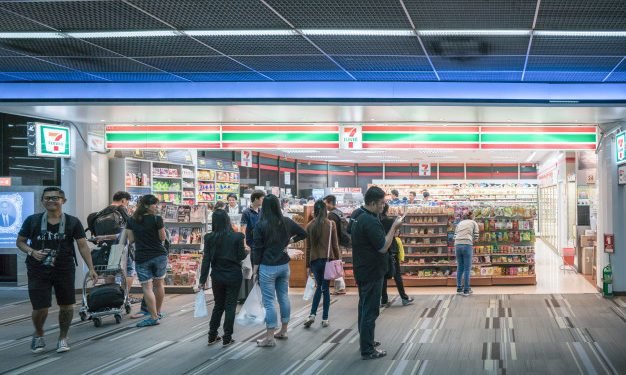
The success of Japan’s convenience stores demonstrates the opportunity in selling food designed for everyday living, not just indulgent moments. This article by Frank Beard, published in C Store Dive, is a great 7 minute read which sets the bar for today's c store food offerings.
Frank is a longtime convenience retail enthusiast in the US who currently works in marketing for Rovertown. His column, The Road Ahead, examines innovation in the c-store industry.
As someone who’s visited more than two thousand stores across the United States over the past decade, along with a handful in a few other countries, that’s not a claim I make lightly, there’s a lot of great food in convenience stores.
It’s why, back in 2016, I was able to comfortably spend 34 days eating at stores across nine states to make a point about healthy on-the-go options. But the food I just ate recently really was the best, and it wasn’t from one chain or even one store. It was the food available at every convenience store I visited in Japan.
As someone involved in several hobbies that invariably lead to the thought, “I should visit Japan,” I was already aware that Japanese convenience stores have a reputation for being some of the best in the world. But I wasn’t prepared for just how good they are — or the fact that so many people seem to miss why that is.
Their excellence is not due to the presence of a few signature products like egg sandwiches and Fami-Chiki, or the fact that they sell other unique food like fruit sandos and onigiri. Those are outcomes of a deeper and more fundamental story. A photo below shows of an array of grab-and-go food items in a cooler case.

Japan has created a national standard of fresh, affordable, high-quality food that’s designed for everyday consumption and the fact is that Japanese convenience retailers have already cracked the code on foodservice. And they did it because the entire industry, led by the country’s three largest chains, created a national standard of fresh, affordable, high-quality food that’s designed for everyday consumption.
Everyone eats at these stores. Not just a few niche groups, but salarymen, tourists, business travelers, retail workers, people running errands, students heading home, families catching a train. According to an Asahi Group Foods survey, roughly a third of Japanese women eat at convenience stores at least three times a week.
Bear in mind that this is in a country with arguably the best restaurant scene anywhere in the world, particularly in cities like Tokyo and Osaka. The fact that their convenience stores are viewed as destinations for food shows that they’re exceptional.
I didn’t fully appreciate this until I experienced it firsthand. Imagine if Pret a Manger suddenly scaled to 50,000 locations, priced their food for everyone and built a supply chain that can replenish each location three or four times per day with fresh food. Then imagine it’s even better than that.
That’s the Japanese convenience store model. And the thing I can’t stop thinking about is that they achieved this without emulating the American quick-service restaurants (QSR's).
Read the full article The Road Ahead: What if c-stores don’t need to become QSRs? | C-Store Dive
Share this: